Montauk Long Island hasn't always been my home. Though my family and I have spent most summers here since the early 60's (and I've always known I would settle here eventually), up until a couple of years ago the S.F. Bay Area was my home of 30 years.
Of course, since moving to Montauk, I still keep in touch with a lot of my California crew. My old friend Linda, who lives just south of San Francisco, in Belmont, CA, regularly sends me clippings from local papers about things she thinks I need to know. Linda and I share a love of gardening, and she's been really interested in my beekeeping adventures. Linda found out that a group of San Francisco Chronicle employees started keeping bees last year, around the same time I did. They keep them on the rooftop of the Chronicle building, right in the middle of the City! Through reading the Chronicle articles that have served as a diary of their project, I learned that Google, whose offices are located in Mountain View, CA (practically in my old backyard) also keeps bees. They started their program about 2 years ago at the company's headquarters. Eighty employees signed up to help tend the bees, and they extracted 400 lbs. of honey from 4 hives in their first year! I freely admit to having felt somewhat envious.
Naturally, I started following the Google and Chronicle teams' exploits (for Google enter "hiveplex" in the search bar at http://googleblog.blogspot.com; the SF Chronicle is at http://www.sfgate.com/columns/honeybeechronicles/). Recently, however, total admiration of what seemed to be runaway successes turned to consternation, empathy and fear. It seems that one of the two hives on top of the Chronicle building has failed - the queen has absconded or died, leaving a few depressed, aimless bees to wander the empty combs; and 3 of the 4 Google hives have failed after the second year.
Interestingly, the one Google hive that survived had been prophylactically treated with antibiotics (to be used as a control group, I think). Google wanted the hives to be managed in a natural way, without the aids (if 'aids' they are) of applied chemicals and medications. The experienced beekeeper who is helping the Googlers has his own apiary, where he does feed antibiotics. Google, understandably, didn't want to sign on to that protocol. The suspected killer of the Google hives was varroa distructor. My blog post #14 gives a full account of these horrible, death-dealing mites that have become the scourge of beekeepers globally.
This brings up the general question - perhaps the biggest one any beekeeper needs to face - about how to manage hives in the face of the myriad pests and pestilence that bees can fall prey to. At the two extremes of the spectrum there is, at one end, those who believe that nothing should come in contact with the bees except hive parts: wood, wax, and maybe wire. They do not believe in dietary supplements, plastic hive parts, feeding with sugar, or medications (whether preventative or curative), and many do not even wear protective clothing when they work the hives. At the other end of the spectrum are beekeepers who throw everything available at their colonies - from artificial pollen patties, to prophylactic antibiotic treatments, to fumigants, to drugs illegally smuggled from foreign countries.
The impetus for the 'natural' end of the spectrum is often spiritually inspired, but it is probably just as often purely practical. Master Beekeeper Ray Lackey, my instructor, has stopped all hive treatments in his 60 hives. If I remember correctly, he said that the first year he lost 50% of his hives to pests and disease, but as survivor colonies replaced the lost populations his losses are now down to 5% annually. That's pretty amazing anecdotal evidence suggesting that bees will breed for hardiness and hygiene (see my blog post #14 again) if given the chance. In this scenario, by the way, bees are not brought in from other parts of the country - a universally common current practice - but are allowed to breed naturally from local stock.
The other end of the spectrum is exemplified by some commercial beekeepers who feel they cannot afford to lose hives, so they feed antibiotics to try to stem the tide of disease (much like in factory farming). Of course then there is the problem of strains of pathogens and pests becoming resistant. And when these chemically-dependant beekeepers are migratory (as many are), moving their apiaries all over the country, the diseases they may have been successful in suppressing in their own hives nevertheless spread to unprotected colonies in parts of the country where their bees visit, mate with, and infect, local populations.
Not surprisingly, hive management has been a huge topic of conversation among our South Fork Beekeeping group, a dedicated band of enthusiasts many of whom met through Ray Lackey's class. I have developed my own strategy and we'll see how well it works: I treated 2 of my 3 hives with an application of formic acid pads to kill varroa mites this past Autumn, after I'd taken the honey off the hives and egg-laying had slowed to a trickle. (In nature, formic acid is a miticide produced by ants. It's a powerfully pungent volatile compound - think smelling salts.) To be honest, I didn't actually want to do even that. But I panicked: in September, at one of the last classes of our course at Cornell Cooperative Extension, samples were taken from the 6 hives in the Riverhead bee yard, and varroa infestation was diagnosed as moderate to severe. (In one of the hives, the bees had been 'treated' with an 'natural' option of powdered sugar applications, which many say controls varroa. The sample that later came from that hive showed just as large a varroa infestation as the 'un-sugared' hives.)
The bees at the Riverhead bee yard came from the same Southern suppliers as my own bees, so I had to conclude that my bees were similarly infested. I made the decision that I was not willing to risk losing my colonies to varroa in my first season. The prospect seemed just too demoralizing. The one edgy decision I made was to not treat Team Purple - the swarm hive I collected in June (I describe the 'taking of the swarm' in post #17). I would use them as a control group. Also, because they were a younger (and therefore smaller) colony, I was afraid of what a significant population drop would due to them - the formic acid will result in some bee deaths along with killing varroa mites.
Had the formic acid treatment endangered the bees or the environment needlessly? The jury is out. What I can say is that the white plastic tray under the screened board at the bottom of my hive was loaded with varroa corpses at the end of the treatment period. Would they have killed my colonies? I don't know, but I now have the satisfaction of knowing that at least I disrupted the varroa breeding cycle for this coming season. Next Autumn my plan is to treat all three hives with formic acid. This will give me some indication of how heavily infested the untreated Team Purple was, compared to the 2 originally-treated hives. If, after the next formic acid treatment, the varroa body count is down significantly compared to the past Autumn, I will consider stopping treatments in the coming years, or treating every 2 to 3 years.
Adopting a strategy for managing an apiary is a complicated issue, and one that I'm sure will take me years to develop. I think the thing is to keep experimenting, learning, and doing research; have realistic goals and expectations; and use common sense. I can say that I do not envision ever again 'importing' bees from another part of the country. That just doesn't make sense to me. I think I can breed all the bees I'll ever need right here in my own backyard. Hell, I went from 2 hives to 3 in my first year, without even trying!
I will keep monitoring the Googlers and Chroniclers. It's a great way to keep up on beekeeping news, including techniques, successes and failures, across the country. And it's a terrific way to stay in touch with my beloved Bay Area.
Finally, speaking of California, when I drove across country a few years ago I brought with me some of my containerized fruit trees. (I have to say that the ability to grow citrus in my own backyard was one of the thrills of living in CA that just never got old.) One of the trees I relocated is a navel orange that is now bowing under the weight of ripe fruit. I keep it in my screened porch which is semi-winterized, meaning that the temp. never goes down much below 50°. In the Spring I move it outside and then haul it back in when frost threatens, generally around late October/November. It's kind of a pain, but well worth it when I have a sweet, juicy reward waiting for me at the end.
My other favorite containerized citrus is the variegated pink Eureka-type lemon. The fruit (and leaves) are striped and the flesh is pink. What a wonder! I first saw it at COPA, the amazing - and tragically now-closed - food/wine/lifestyle complex in downtown Napa, California. The outdoor edible gardens that were arranged in a tidy grid of raised beds was an inspiration the likes of which I had never before seen. I just had to track down the pink lemon (which was actually pretty easy to do). So far it hasn't fruited heavily, producing only a few ripe lemons a year. But this year promises to be a bumper crop, I think. And even if there were no fruit to be had, the heavenly scent of citrus blossoms wafting through the house in the depths of winter is intoxicating.
A diary of beekeeping and other adventures in growing, gathering, producing, preparing, and enjoying food on and around Montauk, L.I.
Monday, March 5, 2012
Thursday, January 5, 2012
#22. Winter at the Beach
Winter is here - finally. The water in the rain barrel now sports a 2-inch-thick block of crystal ice. There have been a few days of blustery - even howling - winds. Nothing like winters past so far, though, where the incessant winds and single-digit temps made one want to put a gun to one's head and pull the trigger - just to stop the shrieking winds.
For me, it's the ideal time to pick oysters. I have a favorite spot, and if I go at low tide, especially after a windy day, I'm likely to find plenty of fat, winter oysters right along the tide line. I brought 50 of the salty gems to a New Year's Eve party at my friends' Wendy and Bert, and they were very well received. Which was nice, since it took me forever, plus a couple of minor stab wounds, to open them. To accompany the oysters, I developed an Asian-inspired mignonette with fresh ginger, green onion, shallots, a little hot sauce, Ponzu sauce, mirin, and rice wine vinegar. Oh, yes, and a few good turns of fresh-ground pink salt and cracked mixed pepper (pink, white, black).
Today was glorious. Cold, but clear blue skies and just a slight breeze. I took the three dogs for a long walk on their favorite beach - the one we call End-of-the-World, and was repaid for my efforts by finding a lobster buoy, torn from its pot and resting on the rocky beach, and it was encrusted with mussels. I tore off a few handfuls and brought them home. After a good scrubbing and refreshing them in seawater, into the pan they went, with some white wine, garlic, parsley, and butter. Within minutes, from beach to bowl, I had a real treat.
Of course, now that winter is truly here, I'm worried about the bees. We've had such mild weather that they've been out and about, doing a lot of flying around. On New Year's Day, which I think was our last warm day, I put jars of heavy sugar syrup, mixed with some honey, on each hive. They sucked them dry. This, after lifting the back ends of each hive to see how heavy, i.e. how much food, they still have. No surprise, Team Red was the heaviest. Not coincidentally, they are the ones who have been flying the least, and so I suppose they've been conserving their stores. Both other hives felt pretty light to me. And the big danger sign is supposed to be how close to the top of the hive the bees are clustering. They travel upwards as they move through their food source during the winter. Last time I went into the hives I had made sure that the bee clusters were at the bottom of the hives, and all the food was above them. Bad news: the bees are at the top of all three hives.
I'm not alone in my concern. The emails have been flying on our bee class' Yahoo group. Many new students are worried about the same thing. And the emergency food of choice during the winter is rolled fondant icing. Yes, the same stuff that often coats wedding cakes. I tried making some the other day, but I didn't like the way it turned out, so I've ordered some on line. It should be here in a day or two. I'll wait for a relatively mild day, then open the hives and place a sheet of fondant on top of the hive bars and push it down a bit between the frames. It will be easily accessible to the bees, and I hope it will do the trick. It will be at least 2 months - and probably longer - before there is anything for them to forage. Two months sounds like an eternity to me.
For me, it's the ideal time to pick oysters. I have a favorite spot, and if I go at low tide, especially after a windy day, I'm likely to find plenty of fat, winter oysters right along the tide line. I brought 50 of the salty gems to a New Year's Eve party at my friends' Wendy and Bert, and they were very well received. Which was nice, since it took me forever, plus a couple of minor stab wounds, to open them. To accompany the oysters, I developed an Asian-inspired mignonette with fresh ginger, green onion, shallots, a little hot sauce, Ponzu sauce, mirin, and rice wine vinegar. Oh, yes, and a few good turns of fresh-ground pink salt and cracked mixed pepper (pink, white, black).
![]() |
| Tiki enjoying End-of-the-World beach |
![]() |
| Mussels bubbling away |
Of course, now that winter is truly here, I'm worried about the bees. We've had such mild weather that they've been out and about, doing a lot of flying around. On New Year's Day, which I think was our last warm day, I put jars of heavy sugar syrup, mixed with some honey, on each hive. They sucked them dry. This, after lifting the back ends of each hive to see how heavy, i.e. how much food, they still have. No surprise, Team Red was the heaviest. Not coincidentally, they are the ones who have been flying the least, and so I suppose they've been conserving their stores. Both other hives felt pretty light to me. And the big danger sign is supposed to be how close to the top of the hive the bees are clustering. They travel upwards as they move through their food source during the winter. Last time I went into the hives I had made sure that the bee clusters were at the bottom of the hives, and all the food was above them. Bad news: the bees are at the top of all three hives.
I'm not alone in my concern. The emails have been flying on our bee class' Yahoo group. Many new students are worried about the same thing. And the emergency food of choice during the winter is rolled fondant icing. Yes, the same stuff that often coats wedding cakes. I tried making some the other day, but I didn't like the way it turned out, so I've ordered some on line. It should be here in a day or two. I'll wait for a relatively mild day, then open the hives and place a sheet of fondant on top of the hive bars and push it down a bit between the frames. It will be easily accessible to the bees, and I hope it will do the trick. It will be at least 2 months - and probably longer - before there is anything for them to forage. Two months sounds like an eternity to me.
Saturday, December 10, 2011
#21. Where's winter?
Here we are in early December, and I have to pinch myself. The weather has been, well, it's been sublime. The bees have been flying like it's springtime. (There is honeysuckle blooming.) I've been using this bonus time to put the gardens to bed.(Gardens...bed...get it?) Normally, by this time of year, we are wearing thermal gloves and ear muffs. The other day, I was outside in a tee shirt. (And a pair of pants, naturally.) The extra-warm weather and extended harvest time has allowed me to reap amazing rewards. Within the last week, I've harvested squash, peppers, tomatillos, the last of the eggplants. Found a few extra potatoes when the tubers started sending up leaves. Dug the last of the Jerusalem artichokes. Still plenty of carrots, beets, parsnips, daikon radishes. And, of course, the arugula will be providing greens throughout the winter.The garden is becoming truly self-sustaining, with much of it perennial, and much more seed-producing. This past season, for instance, all my eggplants came from seed saved from the previous season. They flourished. Most of the tomatoes I grew came from saved seed as well. And several squash varieties. It's kind of thrilling. Of course, the asparagus and rhubarb will keep on giving, year after year, as will the tubers, like horseradish (though I think that's technically a root) and sunchokes. I don't know what the potatoes will do. Will the undug tubers continue to live and reappear in the spring? We shall see.
A few leeks that had gone to seed were an absolute vision of loveliness in the garden - stately, 5 ft. spires topped with beautiful purple globes of blossoms. Each flower head was perpetually blanketed by winged pollinators. All kinds of wasps and bees. Finally, when the flowering ended, I cut them and laid the whole stalks in a disused part of the garden. Now, there is a veritable carpet of thousands of leek seedlings emerging. I will dig these up and bring them inside, to transplant in the spring. Garlic has been wonderful. Every year I seem to miss harvesting a few heads. As a result, a few days ago I dug up a couple hundred garlic sprouts and transplanted most of them in neat blocks. It will be a good harvest next summer of at least 160 heads of garlic. The big question is what to do with my globe artichokes. I grow them in California as a perennial border plant, and they expand every year and send up more and more buds with each passing year. But here on Montauk? I don't know whether to mulch them heavily and hope for the best, or dig them up and overwinter them in the cellar.
This past Wednesday night we had quite a storm. Violent winds that kept me up all night. Rain. Stuff outdoors flying all over the place and banging around in an alarming fashion. Driving rain, but that wasn't a worry. I lay awake in the middle of the night thinking about the bees. I hadn't weighted down the hive covers, because I still have to remove the feeder boxed before I truly bed them down for the winter. I was imagining pieces of hives strewn around the yard. As dawn arrived and the worst of the wind was behind us, I rushed out in my robe to the hives. And, unfortunately, I was right. The hive covers had blown off all 3 hives. Thankfully, the inner covers were intact on two of them, meaning that the bees still had good protection. The vicious yellow hive, however, had the inner cover blown off as well, so the tops of the frames were exposed. I rushed to gather the covers to start protecting the colonies. Well, as soon as I approached the yellow hive - you guessed it: I got attacked by a guard bee who flew at me and got caught in my flowing locks. It couldn't have been much over 40 degrees, so it never occurred to me that the bees would be actually be flying, but that yellow hive...Anyway, I ran at full speed towards the house, looking like a complete madwoman, I'm sure, night clothes flapping behind me, and into the house. I didn't realize that the bee was still in my hair, and somehow she wound up on the living room floor, only to sting Tiki, my puppy, who ran around the house madly for a few minutes, and then was totally okay.
Now we've returned to mild weather again. Nary a breeze, and it was almost tee shirt weather again yesterday. But the brutal wind the other night was a harbinger. Winter is now truly on the way.
A few leeks that had gone to seed were an absolute vision of loveliness in the garden - stately, 5 ft. spires topped with beautiful purple globes of blossoms. Each flower head was perpetually blanketed by winged pollinators. All kinds of wasps and bees. Finally, when the flowering ended, I cut them and laid the whole stalks in a disused part of the garden. Now, there is a veritable carpet of thousands of leek seedlings emerging. I will dig these up and bring them inside, to transplant in the spring. Garlic has been wonderful. Every year I seem to miss harvesting a few heads. As a result, a few days ago I dug up a couple hundred garlic sprouts and transplanted most of them in neat blocks. It will be a good harvest next summer of at least 160 heads of garlic. The big question is what to do with my globe artichokes. I grow them in California as a perennial border plant, and they expand every year and send up more and more buds with each passing year. But here on Montauk? I don't know whether to mulch them heavily and hope for the best, or dig them up and overwinter them in the cellar.
![]() |
| Globe artichoke in December. One week from harvest. |
Now we've returned to mild weather again. Nary a breeze, and it was almost tee shirt weather again yesterday. But the brutal wind the other night was a harbinger. Winter is now truly on the way.
Sunday, November 13, 2011
#20. Bee school is over, but the education has just begun
My novice beekeeping journey that began last February ended last month when our class met for the final session of our nine-month beginner beekeeping course at Cornell Cooperative Extension in Riverhead.
My classmates and I are hardly on our own, however. Besides ordering our bees, our teacher, Ray Lackey, offered a good base of knowledge, including hands-on experience with the classroom's 1/2 dozen hives, a couple of excellent books to get us started, plus an introduction to the LIBC, our Long Island beekeeping club. But perhaps the best resource all of us novices now have is each other; Ray is going to set up a Yahoo Group for all his former students (includes 3 or 4 different classes over 2 or 3 years) so that we continue to have a forum for communication and support, and a number of us from the East End have started our own group, the South Fork Beekeepers (unofficial name). Our group has met three times so far, and each time we came away knowing a little more. An old-time Master Beekeeper, Pete Bizzoso, who lives in Manorville, has joined us every time, and it's great to be able to pick his brains. We also have our own Yahoo Group now, with a current membership of about 15.
The latest meeting was this past Tuesday at my home. There were 8 of us, and the centerpiece of the meeting was going out to work my hives. My swarm hive, Team Purple, had already been 'put to bed' for the winter. I did my last thorough inspection a few weeks ago. 4 boxes had comprised the hive: 3 medium 8-frames for the brood area with a medium super on top that contained mostly drawn comb, and a hive-top feeder above that. I had been sneaking peeks (see the photo in the last blog) and was pleased to see that the bees were taking the sugar syrup down into the super, drying and capping it for the winter. But I'd suspected that I might have some rearranging to do with the lower boxes, and I was right. As it turned out, the bottom box was largely unused. Some of the black plastic Pierco frames had not even been drawn out. So I removed that box. The next box up was heavy with honey, with no brood present. The third box also had good honey stores, and a little bit of brood in the center. Here's the potential problem: we have learned that as bees eat through their stores throughout the winter, they move up - not down -, so having honey below the brood area is not useful. (Apparently, it is not unusual for a beekeeper to open a hive in the Spring to find a colony of starved, dead bees clustered at the top of the hive, with an untouched super full of honey on the bottom of the hive.) So I placed the box with the brood on the bottom, the full box of honey above that, and the partially-filled super over that. The feeder box will stay on top until around Thanksgiving, or until the bees have filled every nook and cranny and stop taking the syrup down.
Based on my last inspection, I knew I had a similar scenario to contend with in the red hive. (Both the red and yellow hives had the same box configuration as the purple hive had had.) One unexpected wrinkle was that Team Yellow had turned so nasty last time I tried to inspect it that I had to give up halfway through the inspection, I was so overwhelmed by a cloud of angry guard bees pummeling my veil. At the time, I wondered if it was the DNA provided by their new queen (that hive swarmed for the second time during the Autumn, so the current queen is new since then). Alternatively, I was afraid that there might be something else insidious going on inside the hive that was stressing out the bees and upsetting them. Apparently, a queenless colony, or a colony infested by pests, can also get testy. Anyway, I decided to wait until I had the supervision of Pete before going into the yellow hive again.
The day of the meeting, Pete wanted to start with the yellow hive. Besides Pete and me, there were 6 fellow beekeepers watching and ready to help. However, as soon as we opened the yellow hive, all but 4 of us headed for the hills - Team Yellow was on the warpath! Pete, who usually doesn't wear gloves or a veil, was stung several times, including a nasty one on the eyelid. A bee got into the crown of my hat, through one of the grommets, and stung me thoroughly on top of my head. Thankfully, all the unsuited onlookers moved far away and were unharmed. Undaunted, Pete put on a veil, and the super-brave Bea and Paige helped us to inspect and reorganize the hive similarly to what I'd done with Team Purple. Interestingly, we found no signs of the stress factors I had been fearing, like an infestation of hive beetles or hive moths. Just a vast number of really aggressive bees.
We moved on to the red hive, and dealt with them in a similar fashion, putting the box with brood on the bottom, with two boxes of honey above. But the mood in the red hive was markedly different from Team Yellow. Box after box, the bees kept to their business and tolerated us extremely well. Note that this is the hive that produced the vast majority of my honey this year - like 60 lbs., compared to 15 lbs. from the yellow hive. All in all, an excellent colony. The yellow hive, in contrast, was problematic from the very beginning, first being weak, then swarming more than once, and finally becoming aggressive. If all three colonies survive the winter, it will be interesting to see how they develop in the Spring. Aggressive bees have a reputation for producing a lot of honey. If that's the case, I may try to tolerate Team Yellow's crankiness. Otherwise, this is a case where I will consider replacing the queen.
My bee friend Josie, at whose home in Springs we met for our last meeting, brought me a fabulous gift when she came to the meeting at my house. She had been caring for 2 hives in Montauk all summer at a lakeside rental of a NY designer. He wanted bees for the summer, so he had them shipped down from upstate NY to the tune of $1500.00, and then gave her the colonies to move back to The Springs when he moved back to NYC after Labor Day. Wow. Anyway, I had gone over one day to help her with the bees, and asked her if she was going to want both the unused nuc boxes that the colonies were originally shipped in. Well, she brought me one of the setups. They are great! Heavy duty plywood construction. 2 deep boxes just 5 frames wide, with a shallow super, plus frames, a lid, and even a queen excluder! I will modify them by cutting them down to medium depth, and I'll be all ready to go in the Spring when a swarm appears, or when I decide to split one of my hives.
I'll end by including a recipe for panmelati, an Italian confection that I made and entered at the LIBC annual honey show last month. (See post #19.) It is modified from a Lidia Bastianich recipe. These make a great holiday treat to finish off a meal, perhaps with a glass of vin santo, eiswein, or other dessert wine. My only criticism is that they are a bit soft, so you might want to try adding more bread crumbs to stiffen up the 'batter'. Also, they keep forever, and would make a terrific hostess gift, especially if made with your backyard honey!
3 cups honey
1 cup fine, dried bread crumbs (see note above)
2 cups toasted walnuts, finely chopped (or try with other nuts)
2 Tbsp. brandy or other alcohol (optional)
vegetable oil
My classmates and I are hardly on our own, however. Besides ordering our bees, our teacher, Ray Lackey, offered a good base of knowledge, including hands-on experience with the classroom's 1/2 dozen hives, a couple of excellent books to get us started, plus an introduction to the LIBC, our Long Island beekeeping club. But perhaps the best resource all of us novices now have is each other; Ray is going to set up a Yahoo Group for all his former students (includes 3 or 4 different classes over 2 or 3 years) so that we continue to have a forum for communication and support, and a number of us from the East End have started our own group, the South Fork Beekeepers (unofficial name). Our group has met three times so far, and each time we came away knowing a little more. An old-time Master Beekeeper, Pete Bizzoso, who lives in Manorville, has joined us every time, and it's great to be able to pick his brains. We also have our own Yahoo Group now, with a current membership of about 15.
The latest meeting was this past Tuesday at my home. There were 8 of us, and the centerpiece of the meeting was going out to work my hives. My swarm hive, Team Purple, had already been 'put to bed' for the winter. I did my last thorough inspection a few weeks ago. 4 boxes had comprised the hive: 3 medium 8-frames for the brood area with a medium super on top that contained mostly drawn comb, and a hive-top feeder above that. I had been sneaking peeks (see the photo in the last blog) and was pleased to see that the bees were taking the sugar syrup down into the super, drying and capping it for the winter. But I'd suspected that I might have some rearranging to do with the lower boxes, and I was right. As it turned out, the bottom box was largely unused. Some of the black plastic Pierco frames had not even been drawn out. So I removed that box. The next box up was heavy with honey, with no brood present. The third box also had good honey stores, and a little bit of brood in the center. Here's the potential problem: we have learned that as bees eat through their stores throughout the winter, they move up - not down -, so having honey below the brood area is not useful. (Apparently, it is not unusual for a beekeeper to open a hive in the Spring to find a colony of starved, dead bees clustered at the top of the hive, with an untouched super full of honey on the bottom of the hive.) So I placed the box with the brood on the bottom, the full box of honey above that, and the partially-filled super over that. The feeder box will stay on top until around Thanksgiving, or until the bees have filled every nook and cranny and stop taking the syrup down.
Based on my last inspection, I knew I had a similar scenario to contend with in the red hive. (Both the red and yellow hives had the same box configuration as the purple hive had had.) One unexpected wrinkle was that Team Yellow had turned so nasty last time I tried to inspect it that I had to give up halfway through the inspection, I was so overwhelmed by a cloud of angry guard bees pummeling my veil. At the time, I wondered if it was the DNA provided by their new queen (that hive swarmed for the second time during the Autumn, so the current queen is new since then). Alternatively, I was afraid that there might be something else insidious going on inside the hive that was stressing out the bees and upsetting them. Apparently, a queenless colony, or a colony infested by pests, can also get testy. Anyway, I decided to wait until I had the supervision of Pete before going into the yellow hive again.
The day of the meeting, Pete wanted to start with the yellow hive. Besides Pete and me, there were 6 fellow beekeepers watching and ready to help. However, as soon as we opened the yellow hive, all but 4 of us headed for the hills - Team Yellow was on the warpath! Pete, who usually doesn't wear gloves or a veil, was stung several times, including a nasty one on the eyelid. A bee got into the crown of my hat, through one of the grommets, and stung me thoroughly on top of my head. Thankfully, all the unsuited onlookers moved far away and were unharmed. Undaunted, Pete put on a veil, and the super-brave Bea and Paige helped us to inspect and reorganize the hive similarly to what I'd done with Team Purple. Interestingly, we found no signs of the stress factors I had been fearing, like an infestation of hive beetles or hive moths. Just a vast number of really aggressive bees.
We moved on to the red hive, and dealt with them in a similar fashion, putting the box with brood on the bottom, with two boxes of honey above. But the mood in the red hive was markedly different from Team Yellow. Box after box, the bees kept to their business and tolerated us extremely well. Note that this is the hive that produced the vast majority of my honey this year - like 60 lbs., compared to 15 lbs. from the yellow hive. All in all, an excellent colony. The yellow hive, in contrast, was problematic from the very beginning, first being weak, then swarming more than once, and finally becoming aggressive. If all three colonies survive the winter, it will be interesting to see how they develop in the Spring. Aggressive bees have a reputation for producing a lot of honey. If that's the case, I may try to tolerate Team Yellow's crankiness. Otherwise, this is a case where I will consider replacing the queen.
My bee friend Josie, at whose home in Springs we met for our last meeting, brought me a fabulous gift when she came to the meeting at my house. She had been caring for 2 hives in Montauk all summer at a lakeside rental of a NY designer. He wanted bees for the summer, so he had them shipped down from upstate NY to the tune of $1500.00, and then gave her the colonies to move back to The Springs when he moved back to NYC after Labor Day. Wow. Anyway, I had gone over one day to help her with the bees, and asked her if she was going to want both the unused nuc boxes that the colonies were originally shipped in. Well, she brought me one of the setups. They are great! Heavy duty plywood construction. 2 deep boxes just 5 frames wide, with a shallow super, plus frames, a lid, and even a queen excluder! I will modify them by cutting them down to medium depth, and I'll be all ready to go in the Spring when a swarm appears, or when I decide to split one of my hives.
I'll end by including a recipe for panmelati, an Italian confection that I made and entered at the LIBC annual honey show last month. (See post #19.) It is modified from a Lidia Bastianich recipe. These make a great holiday treat to finish off a meal, perhaps with a glass of vin santo, eiswein, or other dessert wine. My only criticism is that they are a bit soft, so you might want to try adding more bread crumbs to stiffen up the 'batter'. Also, they keep forever, and would make a terrific hostess gift, especially if made with your backyard honey!
PANMELATI
4 large navel oranges, washed & dried3 cups honey
1 cup fine, dried bread crumbs (see note above)
2 cups toasted walnuts, finely chopped (or try with other nuts)
2 Tbsp. brandy or other alcohol (optional)
vegetable oil
- Peel oranges and clean away all the light-colored pith. Slice into thin strips and dice finely and evenly. There should be about 1 cup.
- Mix peel and honey in a saucepan and heat to a simmer, stirring occasionally, about 5 minutes, or until peel is somewhat translucent.
- Stir in 1 cup of nuts and the crumbs. Simmer, stirring frequently, about 10 minutes, or until the mixture pulls away from the sides of the pan. Stir in brandy. Remove from heat.
- Scrape mixture onto a lightly oiled work surface. When cool enough to handle, break off small pieces and roll with oiled hands. Then roll the balls in the reserved nuts.
Wednesday, October 26, 2011
#19. HONEY COMPETITION: The harvest is in - let the games begin!
I've been moving toward winterizing the bees since early October. This includes checking brood boxes and honey stores and feeding heavy sugar syrup (2:1 sugar to H2O, by weight) as needed. The goal is to have a hive chock full of stores for the winter: all frames should be filled and capped, signaling that the bees have enough to eat until March or so. I'm using styrofoam hive-top feeder boxes, and as you can see, the bees go crazy for the syrup. They are protected from falling into - and drowning in - the syrup by a clear plastic panel that affords them just enough room to maneuver, while providing a foothold so they can rush in and out of the feeding area. Having this kind of 'indoor' feeder is great in that the bees can use it 24/7. In fact, one of my favorite things is visiting late at night just before going to bed, lifting the cover and examining the feeder action by flashlight.
I never did get a late crop of honey, so my total harvest was around 75 lbs., most of it from Team Red. There were some capped frames in all three hives late in September that I could have extracted, but I decided to leave them for the bees. And so I turned my attentions to preparing for my first honey competition, which was to take place in Bethpage, L.I., at a colonial restoration village. In the great tradition of state and county competitive agricultural fairs, the Long Island Fair features all kinds of livestock, produce and crafts from Queens, Nassau and Suffolk counties.
I got some tips about the proper way to present honey for competition from teacher Ray Lackey, mentor Peter Bizzoso, and doing a lot of reading on the internet. One of the most important things in honey competition is cleanliness. Honey must be meticulously strained and free of any foreign objects. The 'queenline' style glass jars - the gold standard for competition - have to be polished and filled to exactly the right level. Even a fingerprint or a piece of lint on the jar will send your score down. That means that after the bottles are washed and polished, they are not touched by ungloved human hands.
I was pretty disappointed with the number of entries. I entered 2 classes: light honey and amber honey. My light entry won second place. First place went to my teacher, Ray Lackey, so I can't complain about that. Problem is that there were only our 2 entries in the class. So if you want to look at it in a different way (which I don't care to do), I came in last. My other class had a total of 3 entries, and I took second again.
The exciting thing, though, and what really made all the effort worthwhile, was that the judging is very formal and you get a detailed score card. I was thrilled that I got high marks for things I could control - like cleanliness. I also got a perfect score in flavor. Moisture and crystal content are what dragged my scores down, and there's little I can do to affect those categories, at least at my current level of knowledge.

After that inaugural experience, I was all ginned up about the prospect of a competition that was to take place in Holtsville, L.I. on October 16, as part of the Long Island Beekeepers' annual meeting. Based on the SRO crowd at the LIBC-sponsored lecture I'd attended (see post #14) I was expecting a heavy turnout. And when I saw the entry form and the number of classes, I was overwhelmed. I decided to enter as many classes as I could, and worked for days to get my entries ready. Besides the 2 colors of honey, I entered the Soft Cookie class, the Candy class, and the Gadget class. Here's an edited version of the LIBC entry details:
![]() |
| A peek under the hood |
I got some tips about the proper way to present honey for competition from teacher Ray Lackey, mentor Peter Bizzoso, and doing a lot of reading on the internet. One of the most important things in honey competition is cleanliness. Honey must be meticulously strained and free of any foreign objects. The 'queenline' style glass jars - the gold standard for competition - have to be polished and filled to exactly the right level. Even a fingerprint or a piece of lint on the jar will send your score down. That means that after the bottles are washed and polished, they are not touched by ungloved human hands.
I was pretty disappointed with the number of entries. I entered 2 classes: light honey and amber honey. My light entry won second place. First place went to my teacher, Ray Lackey, so I can't complain about that. Problem is that there were only our 2 entries in the class. So if you want to look at it in a different way (which I don't care to do), I came in last. My other class had a total of 3 entries, and I took second again. The exciting thing, though, and what really made all the effort worthwhile, was that the judging is very formal and you get a detailed score card. I was thrilled that I got high marks for things I could control - like cleanliness. I also got a perfect score in flavor. Moisture and crystal content are what dragged my scores down, and there's little I can do to affect those categories, at least at my current level of knowledge.
After that inaugural experience, I was all ginned up about the prospect of a competition that was to take place in Holtsville, L.I. on October 16, as part of the Long Island Beekeepers' annual meeting. Based on the SRO crowd at the LIBC-sponsored lecture I'd attended (see post #14) I was expecting a heavy turnout. And when I saw the entry form and the number of classes, I was overwhelmed. I decided to enter as many classes as I could, and worked for days to get my entries ready. Besides the 2 colors of honey, I entered the Soft Cookie class, the Candy class, and the Gadget class. Here's an edited version of the LIBC entry details:
Extracted Honey
Class ONE: One jar of water white honey
Class TWO: One jar of light honey
Class THREE: One jar of light amber honey
Class FOUR: One jar of amber honey
Class FIVE: One jar of dark honey
Comb Honey
Class SIX: One section box of comb honey
Class SEVEN: One package of cut comb 4" square honey
Class EIGHT: One circular section of comb honey
Class NINE: One shallow super frame of comb honey
Class TEN: One shallow super frame of extracting honey
Class ELEVEN: One full depth super frame of extracting honey
Creamed Honey
Class Twelve: 16 oz. clear container of creamed honey
Chunk Honey
Class THIRTEEN: 16 oz. clear container of chunk honey
Novelty Packaged Honey
Class FOURTEEN: One honey-filled container
Beeswax
Class FIFTEEN: Single piece, pure beeswax, weight 2 Ibs.
Class SIXTEEN: Candles, dipped, one pair, pure beeswax
Class SEVENTEEN: Candles, molded, one pair pure beeswax
Class EIGHTEEN: Candles, fancy, one pair pure beeswax
Class NINETEEN: Novelty beeswax, with additives permitted
Mead
Class TWENTY: Mead, DRY
Class TWENTY-ONE: Mead, Sweet
Class TWENTY-TWO: Mead, made with fruit juices
Class TWENTY-THREE: Mead), sparkling, made without fruit juice
Honey Cookery And Gadget Classes:
Class ONE: Cookies, crisp, one dozen
Class TWO: Cookies, soft, one dozen
ClassTHREE: Bars or Brownies, one cake
Class FOUR A: Cake, unfrosted, one cake
Class FOUR B: Cake, frosted, one cake
Class FIVE: Yeast bread, one loaf
Class SiX: Yeast bread, fancy, one loaf
Class SEVEN: Yeast rolls, one dozen
Class EIGHT: Quick bread, (Fruit or nuts optional), one loaf
Class NINE: Muffins, (Fruits or nuts optional), one dozen
Class TEN: Candy, 1/2 ib or 12 pieces
Class ELEVEN: Pie, one pie (rules apply to filling)
Class TWELVE Granola, two cups or more
Class THIRTEEN: products baked with 100% honey used for sweetener
Class FOURTEEN: Honey spreads, 1 jar
Class FIFTEEN: Salads, one container of salad
Class SIXTEEN: Sauce, 1 jar
Class SEVENTEEN: Miscellaneous cookery
ClassEIGHTEEN: Arts and Crafts (Honey labels have been included in this class).
Class NINETEEN; Gadgets
The Sunday morning of the show I loaded up the car with my precious cargo, plus my 3 dogs (an even more 'precious cargo'). Mapquest had indicated that it would take me about an hour and a half to get to the event. I decided to give myself 2 hours. The first indication that the trip would not go smoothly was the virtual parking lot that was Sunday-westbound-Hamptons traffic. Uggh. I'd lost over 1/2 an hour by the time I hit the Long Island Expressway. And Tiki, my 9-month-old puppy was horribly carsick, so I was pulling over to clean her - and her crate - with alarming regularity. Thankfully, she was heartbreakingly brave about the whole thing. Her little tail never stopped wagging, as if to say that nausea was a price she was willing to pay for an adventure.
Alas, the challenges of the trip didn't end with traffic and dog vomit. For some reason I thought that the show was at a lovely site I'd visited (and described in post #12) near St. James. I'd pictured a glorious day out among rolling hills, the dogs frolicking in the fields on what was going to be a warm and lovely afternoon. Only when I drove up to the gates, they were locked. Panic welled up in my throat as I realized immediately that I was in the wrong place. And I was already late. And when I sorted out where I was actually meant to be, I noted that it would take me another half an hour to get there. To add insult to injury, it was back in the direction from whence I'd come. My underarms were clammy; my mouth was dry. Off I went in search of the show.
I finally found where the competition was actually supposed to be, at the Holtsville Ecology Center, a sort of childrens' zoo-cum-park. "No Dogs Allowed" on big signs all over the place. Poor Tiki, I thought fleetingly. And by now I was so late I thought I must have missed the competition. I ran from entrance to entrance, door to door, gate to gate. It was Sunday. Free admission. No employees to be found anywhere, and no sign of anyone who looked remotely like he was a beekeeper.
Eventually I found a couple of security guards and they told me to drive down a no-access road, which they indicated by pointing, turn right at the end, and I'd find my group. Which I did. Drive down the road, that is. There was no group anywhere, except a large group of Canada geese. And the road was wending around and I didn't see any other cars. Just me and tons of joggers, strollers, families. And me. On, what it turns out, was an asphalt jogging trail. I drove for at least a mile or more, creeping along so as not to up-end any pedestrians. And they did look at me kind of quizzically, but surprisingly, I thought, without signs of outrage. I responded by giving my best imitation of a royal wave, and mouthing official business through the windshield. Yeah, 'official business' in my Honda Element with the salt-crusted windows and the California license plates.
And then it got worse. I reached the end of the trail. I had assumed - and hoped - that the trail would be a loop and that would take me back to where I'd started, near the Canada geese. No such luck. I had to turn around and retrace my route back through the now not-at-all-amused fresh air fiends; by now, they'd had time to reflect on my unorthodox use of their trail system. Fists were clenched and raised, middle fingers were brandished. I was sure that there was going to be a squad car waiting for me when I found my way back to Point A. By the time I did make it back, the security guards were gone. Thank God, perhaps.
Daunted, but not quite ready to give up, I decided to explore another no-entry roadway. This time the path landed me behind a grouping of big, ugly prefab steel buildings with metal siding that was peeling off in great curls and punctuated by metal doors that were rusted and corroded around the margins. There were tractors and large dumpsters and dump trucks parked here and there. I was looking around, just taking it all in, now pretty much resigned that my day was a total waste. I was resisting thinking about all the hours I'd spent on preparing for the competition. I could hear a horse whinny somewhere. Through a distant chain link fence I could just make out a pair of emu in a wooden pen. In a far corner was a greenhouse, and through its open door I thought I spied orchids. Perhaps, under different circumstances, this was the kind of place I could enjoy exploring. Just then, a woman appeared from out of the greenhouse. I ran up to her and asked (by now with no expectation that I would ever find the Long Island Beekeepers) if she knew where a group was meeting. She pointed at one of the ugly steel buildings. I creaked open one of the rusted doors, and there they all were. The LI Beekeepers, just finishing up their annual meeting. And though the judging had begun, I was not too late to enter all my stuff.
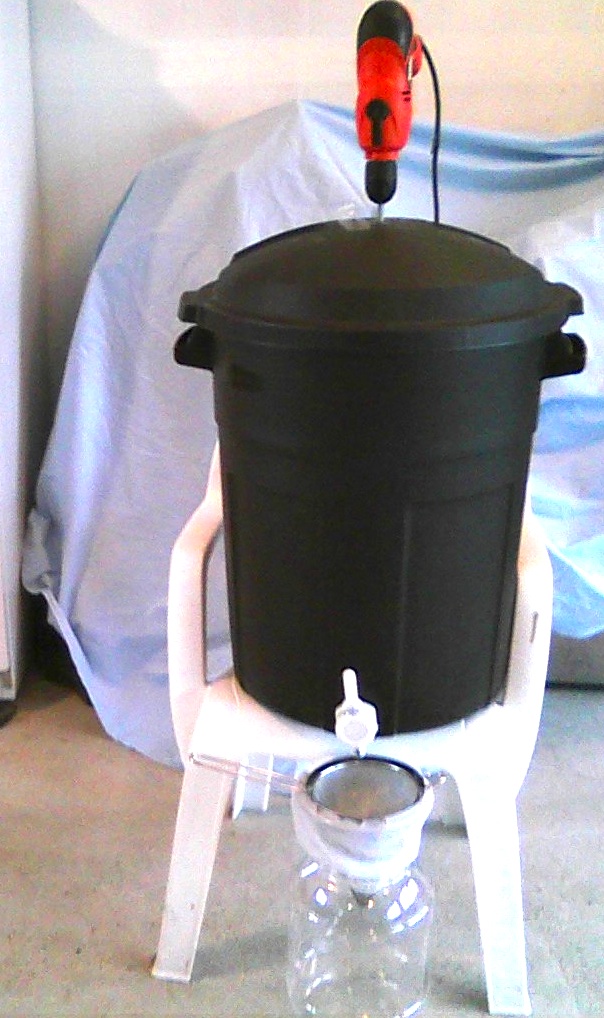
I took first place in every class except light amber honey, where I came 3rd out of 4 entries. But before anyone gets too impressed, I was also the only entry in all the classes I won. (Not to put too fine a point on it, I took a 3rd place in the only class where I encountered actual competition.) And out of the almost 50 classes offered, there were no entries at all in about 35 of the classes. Most classes that did get an entry had only one. It was pretty demoralizing. Clearly, this area of LIBC club activities is atrophying. There was a bright spot, however: my 'gadget' entry - the drill-driven garbage can honey extractor I invented - got the award for Best in Show. It was awarded by my teacher, Ray Lackey, himself an inventor and holder of countless patents, so I considered it a high honor.
![]() |
| My winning garbage can extractor |
Monday, August 29, 2011
#18. A Taste of Honey (and other things).
A follower of this blog emailed me the other day. She was concerned that something had happened to the bees and that's why I hadn't been blogging. I'm happy to report that the bees are doing fabulously well. It's just that I've been swamped. What with summer guests, gardening, and now harvesting and processing the fruits of my labor, well, I guess the blog just took a back seat. Actually, I was so on top of things in June that I started a blog post that I never finished. I'm going to post that June draft now, because it will set up the current scenario a bit:
Over the last month I have been trying to aggressively manage the hives, moving frames around so that I can eventually replace the cruddy, old, original deep nuke frames with nice, new, properly-sized medium Pierco frames. The theory is this: bees keep their colonies organized in a spherical cluster. The nucleus of that cluster is where most of the egg-laying and brood-rearing takes place. By gradually moving center frames out toward the edge of the brood box, the bees will convert that comb to honey and pollen storage receptacles instead of brood cells, once the existing brood hatches. Empty of brood and, with luck, filled with honey, the over-sized old frames can be removed without compromising the population of the colony. So far I've managed to remove all 5 of these deep frames from the Yellow Hive, and 3 from the Red Hive.
Some of the frames I removed contain uncapped (or 'unripe') - and some capped - honey. One of these I placed atop the Yellow Hive, sitting inside the now-disused hive-top feeder box. Theoretically, the bees will go up into the feeder, unload the frames of its sweet cargo and re-pack it down below, either in the brood boxes or in the honey super.
I couldn't help myself. I brought out a metal spatula and plastic storage container from the kitchen. I reached into the feeder box, held fast the frame and dug deep into the soft comb. Honey oozed and flowed as I pushed the spatula through the wax. I spooned the luscious, gooey ribbon into the plastic cup and stole away to the house to savor my loot. Can I say that it was the most deliciously fragrant, palest, most delicate honey I'd ever tasted? Yes, I can. The aroma of something like lemon blossom lingered in my mouth long after I'd swallowed.
It's been a month since I captured the swarm from the yellow hive. I wanted to give them some time to settle, so I waited two agonizing weeks before I did an inspection. But Ray, my bee teacher, had instructed me to get a second story on the single brood box as soon as possible.
I didn't know what to expect in this new hive. Either my original Yellow Queen was in there, or there was a newly-hatched queen who would have had to go on a successful mating flight before she started laying. What I found surprised and delighted me. The queen practically introduced herself to me when I pulled out one of the center frames. She was dancing and wiggling around in the middle of the frame. It was a new queen. She was born here. That means that this is a 100% Montauk colony of bees. And the most thrilling discovery was that the queen was laying. She had flown off into the 'drone zone' and had found her way back and was busy depositing countless tiny, rice-shaped eggs in the bottom of the cells. I also found larva, but no capped brood yet, so she'd been laying for about a week.
The fact that this was not the original queen from the yellow hive, but a newborn queen, would seem to indicate that I had missed the primary swarm from the yellow hive. Most likely, the old queen had gone off with a large contingent, and this was a secondary swarm. I don't know where they are, but I wish them well. The new queen's small band of daughters who had accompanied her from the yellow hive were feverishly drawing comb and tending to their tiny larval charges. I was worried that there were simply not enough of them to get the job done. It would be about 2 weeks before new bees hatched and were able to help with the household chores. I added another box with new frames, put some more broken, nectar-filled comb into the feeder and went away, fingers crossed.
So far, it looks like I needn't have worried. Last week I added another frame of honey, from the super above the red hive, just to help them out with a house-warming gift of stored food. I didn't see the queen on this most recent inspection. She may have been in the lower level of the hive, which I didn't check. I did see plenty of eggs, larva, and capped brood this time, and so it looks like the swarm hive - Team Purple - is settling in nicely. Now that I have a viable third hive, I will be ordering proper hive parts - a cover, a couple of more supers with frames, a bottom board with a varroa screen.
Below are some of my favorite late-spring things:
New garlic
The last of the robin chicks about to fledge from my front porch
over-wintered giant leeks (about 30 inches worth)
Well, that was then, and this is now. And it's hard for me to know where to begin. I ordered the parts and organized Team Purple into a proper hive. It's been about a month since then, and they seem to be doing fine. I stole some partially-drawn frames, and some nectar-filled frames, from the hard-working red hive, and added them to the purple hive in order to give them a running start on building their colony. I didn't add a honey super, thinking they wouldn't have the time or 'girl power' this year to make excess stores; I wanted them to concentrate on filling out all the frames in the 3-box hive. Now, I have to say, I'm actually thinking of putting a super on, even though it's late in the season. That's how well they seem to be doing.
The taste of honey I had in mid June was just the beginning. A month later, I started to extract honey, mostly from the red hive. I also extracted some honey from the discarded large nuc frames that I took out of the red and yellow hives. These are now all gone, replaced with new black Pierco frames, with the exception of one that remains in the red hive. I will be removing that soon, and replacing it with two drawn frames from which the honey has been extracted.
Some of the honey I harvested by hand - mushing and mashing the wax to break it up, then pushing against a sieve, and finally straining through a coffee filter cone lined with a new nylon stocking. Messy. Then I was invited to join a newly-formed group of bee enthusiasts in Sag Harbor. We met at a lovely woman's home, named - wait for it - Bea! Bea had a new extractor that she allowed us to use. I extracted 4 more frames. So far, I have harvested 22 lbs. of honey!! It is the palest of pale gold and wonderful.
I would have been quite happy with 22 lbs. of honey, but it doesn't end there. Team Yellow looks like it will be filling its honey super, and team red just keeps going and going. There are 2 supers on and I took a peek a few days ago and I think they may both be almost ready to harvest. If that's the case, I could have as much as 60 more lbs. of honey. Frankly, it is unfathomable how much of the sweet stuff they're producing.
We just experienced Hurricane Irene yesterday. Today is clear, calm, dry and sunny. Yesterday and Saturday were another thing altogether. And, of course, the bees were my biggest concern. They are on high ground, so flooding was not a concern, but the wind was. I bungied them to the hive stands and put cinder blocks on the covers and on the hive stands as well. They survived, and are out and about today, doing their thing, appearing no worse for the wear.
It now feels as though the hives have been here forever. Was it really just a couple of months ago that I doubted that they would thrive? Soon it will be time to prep for winter, and that will offer another reason to fret. Still, I just can't imagine life without bees any more.
Saturday, June 18, 2011
#17. Swarm warning
Wednesday was bee class in Riverhead. The topic of the evening's lecture was requeening, that is: why, when, and how to replace the existing queen with a new model.
In feral colonies and unmanaged hives, the worker bees take matters into their own 'hands'. When they determine that a queen is failing, they will raise a new queen and kill the reigning monarch, as in "The queen is dead - long live the Queen!" Queens emit pheromones, and these airborne organic compounds are what give the queen her mojo and knit the hive together. 14 distinct pheromones have been identified in queens. When, due to age or infirmity, the queen's capacity to produce these pheromones in sufficiently potent quantities wanes, the word spreads through the colony instantly, and the workers start to raise a replacement for her. They modify a wax worker cell to accommodate a queen's larger frame and they modify the diet of the newly-hatched larva within to 100% royal jelly, and - voila! - about 2 weeks later a new queen emerges. Just beforehand, the workers will kill their mother and dump the body - or body parts if they've dismembered her - outside the hive.
Of course, the newly-emerged queen is a virgin and must be mated before she is a viable matriarch. She mates on the wing - often far from the hive - and, (and it's a big "and") has to make it back to the hive without getting lost, and in one piece, avoiding birds, wasps and other death traps along the way. Apparently only about 10% of queens don't make it back, which I think is pretty good, given the risks. And if she doesn't make it back, the colony is doomed; there is no queen to produce any more workers. In theory, if a beekeeper is on top of things, she can spot a queenless hive and buy a queen, if she can find one and introduce it to the hive without getting her killed. All I can say is that if a queen gets lost in any of my hives, they're probably out of luck.
In my blog post #9 I explain the queen's mating rituals and I also promised to make corrections if I found I'd misstated something. Well, I need to fine-tune details about the mating flights. I understood that the queen needed to return to the hive after every mating, to be groomed by house bees in preparation for her next encounter with an airborne drone. Not so. On each mating flight (there can be several) she will mate multiple times, each subsequent successful suitor grabbing her, mid-air, and yanking out his predecessor's trailing entrails before thrusting his own 'member' in her 'sting chamber' and thus disemboweling himself. By the way, there was a lot of chatter regarding post #9 and my use of the term 'bee vagina'. Well, as it turns out, that is what it's called. In a jaw-droppingly fascinating passage about historical attempts to artificially inseminate queens (as in creating an artificial to-scale steel bee penis!) in Hannah Nordhaus's excellent book The Beekeeper's Lament, there it is, on page 189, a reference to a bee vagina. So there. (By the way, read the book and you will probably never buy imported honey again. You may also have second thoughts about eating almonds...)
It is not just in times of crisis that bees will raise new queens, however. When times are good and the colony experiences an explosion in their numbers, they take the opportunity to go forth and multiply by swarming. The sitting monarch will sally forth with a contingent of several thousand loyal daughters. They will leave the hive, often around the middle of the day. The air fills with a massive cloud of bees and, almost cartoon-like, they follow their queen onto a nearby branch, split-rail fence, or some other temporary hitching post, until scout bees locate permanent new digs, usually a mile or more away, preferably in a hollow tree - less preferably under someone's porch.
When my beekeeping class began in February we were told that first-year hives generally don't swarm; they're too busy building up a nascent colony to think about expansion plans. And, of course, our queens were young when they arrived and so not likely to be replaced by the colony. So it was with some surprise that I learned from my bee buddy Mike that his bees swarmed early in May. Multiple 'secondary' swarms from the same hive followed, which is common, as it turns out. Mike managed to capture 2 of the swarms, so he has now gone from 1 hive to 3 - all in year 1! (If this happens every year...well, just do the math. He would have over 200 hives in 5 years, almost 650 hives in 6 years. Yikes. Did I do that right? Jorg, help me out here, please!) And it turns out that there were classmates other than Mike whose bees swarmed within the last month. So a lot of Wednesday night's class was devoted to swarms: understanding them and managing them, which dovetailed nicely into the subject of queen replacement, which is part of swarm management.
Well, as it happens, yesterday afternoon, around 2 pm, my ward and protege, Jaime, made a trip to the town dump. Even though it's one of my favorite excursions, I decided to stay home and continue gardening. If I had gone with Jaime, I would have missed all the action, because by the time Jaime returned, the mass exodus from the yellow hive was over. I don't think I would have noticed the tight bundle of bees, hanging, like a fuzzy football, hidden among the boughs of a red cedar: the only residual clue that my bees had swarmed.
The first thing you notice during a swarm event is the unmistakable din - the hum of thousands of bees, levitating, filling the air above the hive. And I'll admit it: it crossed my mind to ignore the entire episode - heck, if I'd gone to the dumps with Jaime...
I couldn't believe it!! We'd had a lecture about swarming Wednesday night, and not 24 hours later I had a swarm! What are the odds? Of course, being the micro-managing control freak that I am, ignoring the swarm wasn't really an option, was it? So I started scrambling around to jerry-rig a Hive #3, what will become Team Purple, if they survive the transition from swarm to managed colony without dying or absconding.
I had an extra medium super I could use as a mini brood box. And I had plenty of new frames. I quickly made a bottom board out of a piece of scrap plywood. Glued and nailed thin cedar battens around 3 sides - the forth side would provide the hive with an entrance. To mitigate the lack of depth in a single medium box, I added a 'slatted bottom board' between the plywood bottom board and the hive body, which should give the bees some extra wiggle room. I initially placed just 2 frames, one on either side of the brood box. Then I bungeed the whole affair together so that I could move it around as a unit.
I had read that it is best to move a swarm in the evening. So around 7 pm, when the bees were tightly balled and content - "drunk with love", as Mike says - I sprayed them down pretty thoroughly with sugar water. I think they liked it, and they're less likely to fly around when they're coated in syrup. Then I placed and steadied my grandfather's old wooden ladder (oh! how I wished he were alive to witness this!) right under the swarm. When I put the hive box on top of the ladder, it was just a few inches from the bottom of the swarm. With my left hand I grasped the pliant cedar bough just above the swarm and pulled gently, lowering the ball of bees into the box. I clutched a big stick in my right hand and, holding my breath, gave the cedar branch a couple of good whacks, until every bee had dropped from the branch into the bottom of the box. I covered the hive, still perched on top of the ladder, with a piece of loose plywood, and retreated.
When I checked back 15 minutes later, I witnessed a behavior that Ray Lackey had described in class on Wednesday. On the lip of the box, around the wide crack created by the warped plywood cover, an orderly conga line of bees had assumed the position - faces to the floor, butts in the air, wings beating madly. They were fanning their queen's pheromones out into the atmosphere, calling all their sister bees who might have been detoured or waylaid during the swarming melee.
Shortly before dark I clasped the new hive box in gloved hands and carefully - oh, so carefully - picked my way through the rocks and weed piles about 20 yards to a quickly-improvised hive stand. Once I placed the hive, I lifted the plywood lid. All the bees were covering one of the wide inner sides of the box and the adjacent frame. I removed the bungees and carefully slid in 6 more frames - one with partially-drawn comb 'borrowed' from the red hive's honey super. I placed a disused feeder box on top of the hive box. In it I laid a deep frame - one of the original nuc frames from the yellow hive, which was partially filled with uncapped honey. I hope they like it. Then I slapped a piece of plywood atop the makeshift hive, weighed the rickety cover down with rocks, and said good night.
So why did Team Yellow swarm? It's possible that, early on, I was overly concerned with their seeming lack of oomph (compared to Team Red), and that when I switched the positions of the red and yellow hives on the hive stand, thereby artificially increasing the number of bees in the yellow hive, I created a swarm condition. I don't know. And who wears the crown in the purple hive? If I find a blue dot on that queen I will know that she's my original, marked queen from Team Yellow. If so, I now have a virgin queen in the yellow hive, with all the uncertainty that situation implies. If it's an unmarked queen in the purple hive, maybe I missed the primary swarm and this is an after-swarm. And will there now be more swarms to come?
Stay tuned...
In feral colonies and unmanaged hives, the worker bees take matters into their own 'hands'. When they determine that a queen is failing, they will raise a new queen and kill the reigning monarch, as in "The queen is dead - long live the Queen!" Queens emit pheromones, and these airborne organic compounds are what give the queen her mojo and knit the hive together. 14 distinct pheromones have been identified in queens. When, due to age or infirmity, the queen's capacity to produce these pheromones in sufficiently potent quantities wanes, the word spreads through the colony instantly, and the workers start to raise a replacement for her. They modify a wax worker cell to accommodate a queen's larger frame and they modify the diet of the newly-hatched larva within to 100% royal jelly, and - voila! - about 2 weeks later a new queen emerges. Just beforehand, the workers will kill their mother and dump the body - or body parts if they've dismembered her - outside the hive.
Of course, the newly-emerged queen is a virgin and must be mated before she is a viable matriarch. She mates on the wing - often far from the hive - and, (and it's a big "and") has to make it back to the hive without getting lost, and in one piece, avoiding birds, wasps and other death traps along the way. Apparently only about 10% of queens don't make it back, which I think is pretty good, given the risks. And if she doesn't make it back, the colony is doomed; there is no queen to produce any more workers. In theory, if a beekeeper is on top of things, she can spot a queenless hive and buy a queen, if she can find one and introduce it to the hive without getting her killed. All I can say is that if a queen gets lost in any of my hives, they're probably out of luck.
In my blog post #9 I explain the queen's mating rituals and I also promised to make corrections if I found I'd misstated something. Well, I need to fine-tune details about the mating flights. I understood that the queen needed to return to the hive after every mating, to be groomed by house bees in preparation for her next encounter with an airborne drone. Not so. On each mating flight (there can be several) she will mate multiple times, each subsequent successful suitor grabbing her, mid-air, and yanking out his predecessor's trailing entrails before thrusting his own 'member' in her 'sting chamber' and thus disemboweling himself. By the way, there was a lot of chatter regarding post #9 and my use of the term 'bee vagina'. Well, as it turns out, that is what it's called. In a jaw-droppingly fascinating passage about historical attempts to artificially inseminate queens (as in creating an artificial to-scale steel bee penis!) in Hannah Nordhaus's excellent book The Beekeeper's Lament, there it is, on page 189, a reference to a bee vagina. So there. (By the way, read the book and you will probably never buy imported honey again. You may also have second thoughts about eating almonds...)
It is not just in times of crisis that bees will raise new queens, however. When times are good and the colony experiences an explosion in their numbers, they take the opportunity to go forth and multiply by swarming. The sitting monarch will sally forth with a contingent of several thousand loyal daughters. They will leave the hive, often around the middle of the day. The air fills with a massive cloud of bees and, almost cartoon-like, they follow their queen onto a nearby branch, split-rail fence, or some other temporary hitching post, until scout bees locate permanent new digs, usually a mile or more away, preferably in a hollow tree - less preferably under someone's porch.
When my beekeeping class began in February we were told that first-year hives generally don't swarm; they're too busy building up a nascent colony to think about expansion plans. And, of course, our queens were young when they arrived and so not likely to be replaced by the colony. So it was with some surprise that I learned from my bee buddy Mike that his bees swarmed early in May. Multiple 'secondary' swarms from the same hive followed, which is common, as it turns out. Mike managed to capture 2 of the swarms, so he has now gone from 1 hive to 3 - all in year 1! (If this happens every year...well, just do the math. He would have over 200 hives in 5 years, almost 650 hives in 6 years. Yikes. Did I do that right? Jorg, help me out here, please!) And it turns out that there were classmates other than Mike whose bees swarmed within the last month. So a lot of Wednesday night's class was devoted to swarms: understanding them and managing them, which dovetailed nicely into the subject of queen replacement, which is part of swarm management.
Well, as it happens, yesterday afternoon, around 2 pm, my ward and protege, Jaime, made a trip to the town dump. Even though it's one of my favorite excursions, I decided to stay home and continue gardening. If I had gone with Jaime, I would have missed all the action, because by the time Jaime returned, the mass exodus from the yellow hive was over. I don't think I would have noticed the tight bundle of bees, hanging, like a fuzzy football, hidden among the boughs of a red cedar: the only residual clue that my bees had swarmed.
The first thing you notice during a swarm event is the unmistakable din - the hum of thousands of bees, levitating, filling the air above the hive. And I'll admit it: it crossed my mind to ignore the entire episode - heck, if I'd gone to the dumps with Jaime...
I couldn't believe it!! We'd had a lecture about swarming Wednesday night, and not 24 hours later I had a swarm! What are the odds? Of course, being the micro-managing control freak that I am, ignoring the swarm wasn't really an option, was it? So I started scrambling around to jerry-rig a Hive #3, what will become Team Purple, if they survive the transition from swarm to managed colony without dying or absconding.
I had an extra medium super I could use as a mini brood box. And I had plenty of new frames. I quickly made a bottom board out of a piece of scrap plywood. Glued and nailed thin cedar battens around 3 sides - the forth side would provide the hive with an entrance. To mitigate the lack of depth in a single medium box, I added a 'slatted bottom board' between the plywood bottom board and the hive body, which should give the bees some extra wiggle room. I initially placed just 2 frames, one on either side of the brood box. Then I bungeed the whole affair together so that I could move it around as a unit.
I had read that it is best to move a swarm in the evening. So around 7 pm, when the bees were tightly balled and content - "drunk with love", as Mike says - I sprayed them down pretty thoroughly with sugar water. I think they liked it, and they're less likely to fly around when they're coated in syrup. Then I placed and steadied my grandfather's old wooden ladder (oh! how I wished he were alive to witness this!) right under the swarm. When I put the hive box on top of the ladder, it was just a few inches from the bottom of the swarm. With my left hand I grasped the pliant cedar bough just above the swarm and pulled gently, lowering the ball of bees into the box. I clutched a big stick in my right hand and, holding my breath, gave the cedar branch a couple of good whacks, until every bee had dropped from the branch into the bottom of the box. I covered the hive, still perched on top of the ladder, with a piece of loose plywood, and retreated.
When I checked back 15 minutes later, I witnessed a behavior that Ray Lackey had described in class on Wednesday. On the lip of the box, around the wide crack created by the warped plywood cover, an orderly conga line of bees had assumed the position - faces to the floor, butts in the air, wings beating madly. They were fanning their queen's pheromones out into the atmosphere, calling all their sister bees who might have been detoured or waylaid during the swarming melee.
Shortly before dark I clasped the new hive box in gloved hands and carefully - oh, so carefully - picked my way through the rocks and weed piles about 20 yards to a quickly-improvised hive stand. Once I placed the hive, I lifted the plywood lid. All the bees were covering one of the wide inner sides of the box and the adjacent frame. I removed the bungees and carefully slid in 6 more frames - one with partially-drawn comb 'borrowed' from the red hive's honey super. I placed a disused feeder box on top of the hive box. In it I laid a deep frame - one of the original nuc frames from the yellow hive, which was partially filled with uncapped honey. I hope they like it. Then I slapped a piece of plywood atop the makeshift hive, weighed the rickety cover down with rocks, and said good night.
It was a miserable, rainy, cool morning today when Jaime checked Team Purple. The bees are still there. Glad I gave them some food as they won't be foraging in this weather.
Stay tuned...
Subscribe to:
Posts (Atom)